
Bear Lake Jail Release Paths
The “Bear Lake County Jail” name is best understood as the county Sheriff’s detention and records function. Official county sources establish the Bear Lake County Sheriff’s Office as the custodian of local jail records, but they do not publish a separate facility page, capacity, release desk, release door, property procedure, or release schedule. Commercial directory claims should not fill those gaps. The official record must control.
A local booking can end in several ways. A person may leave on bond or recognizance, complete a county sentence, be released after a court order, or move to a receiving jail. A felony commitment shifts custody to the Idaho Department of Correction. A federal or immigration hold can also create a transfer. Only the first group clearly describes a community release. The Sheriff’s release disposition and destination should say which path occurred.
Confirm Bear Lake Jail Releases
No official Bear Lake roster, daily booking page, 24-hour list, or 72-hour list was found. Confirmation starts with a narrow request to the actual custodian. The broader Bear Lake County released-inmate search explains how county, court, IDOC, and federal records fit together.
- Call the Bear Lake County Sheriff’s Office and provide the person’s name and approximate booking dates. Ask whether the last event was release or transfer.
- Request the booking number, admission date and time, actual release or transfer date and time, disposition, releasing authority, and destination.
- Check Idaho VINE linked by the Sheriff for the source agency’s recorded custody event.
- Use Idaho iCourt to compare bond, judgment, sentence, warrant, or dismissal activity with the custody event.
- If a transfer is reported, confirm admission and any later release with the named receiving agency.
These sources answer different questions. The jail record documents physical movement. The court docket documents legal authority. VINE reports events supplied by participating agencies and may lag. Agreement among the dated records provides much stronger proof than a missing roster name.
Bear Lake Jail Record Requests
The Sheriff accepts focused requests for jail material. Its form asks for incident details, date and time of incarcerations, and a category such as jail, records, media, 911, or other. A booking photograph should be requested as a separate media item. Idaho law permits redaction of exempt law-enforcement, victim, confidential, or safety information, so a narrow request for finalized administrative fields is usually clearer than asking for an entire arrest file.
Bear Lake County Sheriff’s Office30 N. Main Street
P.O. Box 365
Paris, ID 83261
208-945-2121
Fax: 208-417-1858
Monday through Friday, 8:30 a.m. to 5 p.m.
Use the BLCSO record-request instructions or the Sheriff’s public-record form. The county may contact the requester about lawful fees or advance payment. No fixed booking-photo fee is published, and the civil-process fee schedule is not a jail-record price list.
The official BLCSO request page shows the local channel for obtaining the custody event.
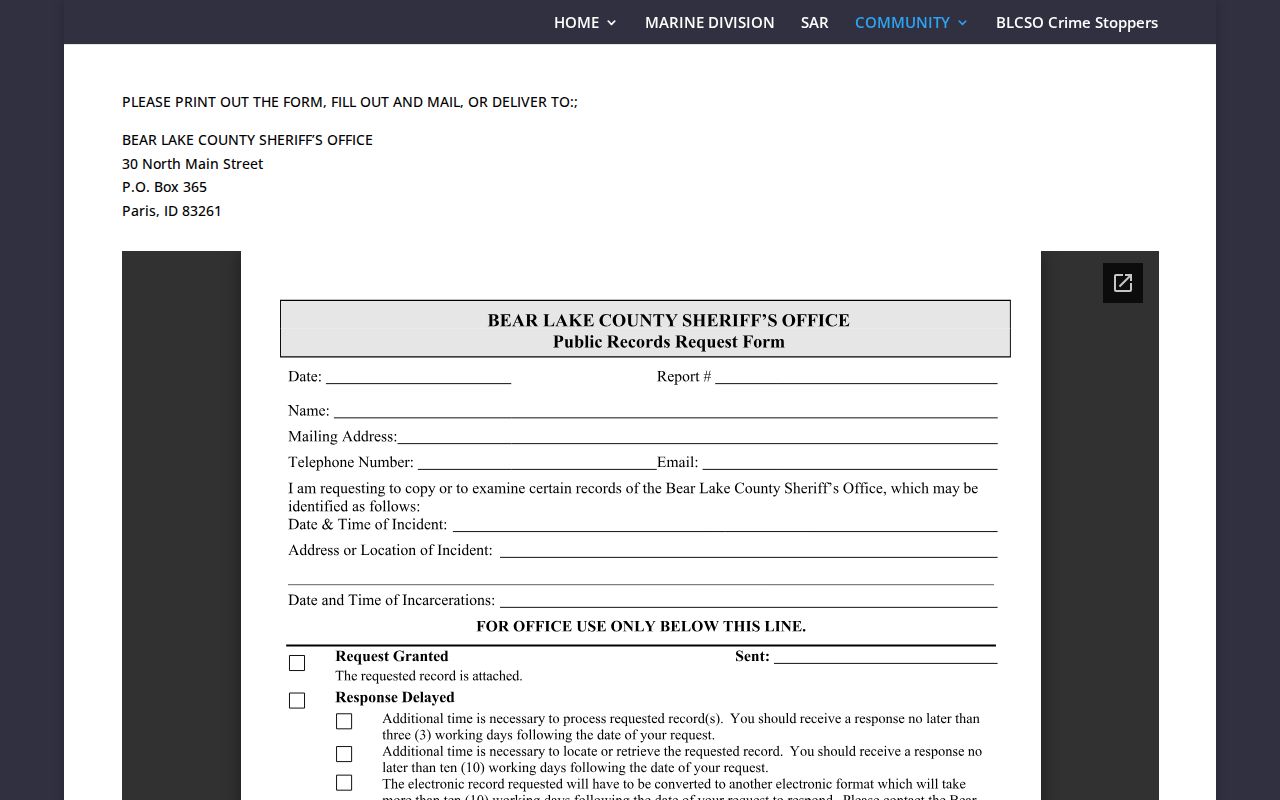
The page supports the request route; the written response supplies the person-specific release or transfer facts.
Bear Lake Release Record Fields
A useful response identifies the event rather than merely saying that a person is no longer present. Ask for fields that distinguish release from transport and establish a date chain.
| Field | Why it matters |
|---|---|
| Booking number and admission | Links the response to the correct custody episode. |
| Release or transfer time | Establishes when Bear Lake physical custody ended. |
| Disposition or release type | Distinguishes bond, sentence completion, court release, and transfer. |
| Releasing authority | Connects the event to a court, custodian, or other legal source. |
| Destination or receiving agency | Shows whether custody continued elsewhere. |
| Bond information | Helps reconcile the jail event with the pending court case. |
A booking photo does not prove present custody or release. It captures an earlier admission. The dated administrative record and later court or receiving-agency record carry more weight for release verification.
Historical Bear Lake Holding Pattern
The county comprehensive plan describes a seven-adult-male Montpelier arrangement and says other prisoners were sent mainly to Bannock County. Nearby passages rely on late-1990s and circa-2000 conditions. That makes the passage historical context, not proof of a current contract, capacity, or routine destination.
The old arrangement still explains why a Bear Lake arrest may produce a fragmented paper trail. Yet Bannock County should never be searched by default. Ask BLCSO whether transport actually occurred, when Bear Lake custody ended, and which agency accepted the person. Then request the receiving admission and later disposition from that custodian.
Note: Geographic closeness and an old county plan do not establish a present housing agreement or a particular person’s custody path.
Bear Lake Jail Records Law
Idaho’s Public Records Act governs access. Current state guidance describes response periods of up to ten working days for an Idaho resident and up to thirty-five days for a nonresident, with applicable extension rules. For residents, the first two processing hours and first 100 pages are free. Beyond that point, Idaho Code section 74-102 permits actual qualified labor and copying charges under the statute.
Not every law-enforcement record is open in full. Idaho Code section 74-124 and related exemptions may protect active investigative facts, victims, confidential sources, safety information, and other restricted material. The office should disclose reasonably separable public parts and explain a denial. A request for the booking and release event, dates, disposition, destination, and photo keeps the scope tied to the release question.
After a Bear Lake Transfer
A person committed on an Idaho felony sentence enters IDOC jurisdiction. The IDOC Resident/Client Search covers incarcerated people, felony probation clients, and parole clients. “In community” or released to supervision means prison confinement ended while state jurisdiction continued. “Discharged” or sentence satisfaction describes the end of that jurisdiction and should be backed by the underlying IDOC and court records.
Federal and immigration transfers require different tools. A BOP result can document a federal prison release, but it does not rule out supervision or later state custody. An ICE transfer closes the county booking without proving a return to Bear Lake County. Ask for the receiving agency first, then use that system’s record rather than forcing every case through a county-jail search.
Bear Lake Release Verification Example
Suppose BLCSO confirms that a booking closed at a stated time and lists another jail as the destination. That is a transfer record. The next task is not to search for a community release, but to match the receiving admission. If the receiving jail later records bond, time served, or another transfer, that second event determines what happened next.
If BLCSO instead identifies bond and iCourt shows a matching bond order, the two records support a community release from that custody episode. Even then, a separate warrant or hold could affect the broader status. State the narrow finding: the named Bear Lake booking ended under the documented disposition.
If VINE differs from the custodian’s dated record, ask which agency supplied the event and when it updated. The custodian’s administrative movement record is the stronger source for the actual physical event, while the court remains the source for legal authority.
Bear Lake Custody Terms
Precise language prevents a release record from being read too broadly. These terms describe different outcomes.
- Community release
- The person leaves the custodial setting without an immediate transfer to another custodian.
- Transfer
- One booking closes because custody moves to another jail, IDOC, USMS, ICE, or another authority.
- Parole
- Prison confinement ends while IDOC jurisdiction and community supervision continue.
- Discharge
- The correctional sentence or jurisdiction ends, subject to what the official record states.
- Time served
- A custodial term is credited as complete, though another hold may still apply.
Ask the records office to preserve its own terminology. A plain-language explanation can follow, but the exact disposition should remain visible.