
Bear Lake Scheduled Versus Actual Release
A scheduled date is a forecast based on the sentence and information available when the record was updated. An actual release is a completed custody event. For Bear Lake County, a state prison result may show parole eligibility, tentative parole, scheduled termination, sentence satisfaction, or Released to Supervision. Each label describes a different stage. A county jail record may instead show the precise exit or transfer time.
Pretrial custody is driven by court orders, bond, unresolved holds, and case events, so a person awaiting trial often has no dependable projected date. A sentence stated in days does not by itself account for credited time, another case, or a transfer. Confirm the judgment and ask the custodian for the official computation.
Find Bear Lake Projected Dates
First identify the system. The Bear Lake County Sheriff's Office documents a local jail episode, while IDOC calculates a state sentence. The court supplies the judgment and qualifying credit. The Commission decides discretionary parole. These agencies do not publish one shared date.
- Check the public court case for custody type, judgment, sentence, and amended orders.
- For an Idaho felony commitment, open the IDOC Resident/Client Search and search by name or IDOC number.
- Copy the exact date label and the page's update date. Do not shorten Tentative Parole Date to release date.
- Compare parole action with the Commission decisions and current hearing schedule.
- For a county sentence, ask the Sheriff's Office and court clerk for the judgment, credited jail time, computed end date, and actual event.
- After the expected date, confirm Released to Supervision, Discharged, or a dated custody release rather than relying on the old forecast.
The Bear Lake County released-inmate record path helps when the person is already out. If the person is still held, use the current custodian's channel rather than a recent-release list.
Idaho Release Labels Matter
Idaho uses unusually exact vocabulary. Parole Eligibility Date is the earliest possible date for parole consideration, normally the start of the indeterminate term. Next Parole Hearing Date is procedural. Tentative Parole Date follows a grant but remains conditional. Released to Supervision is an actual move into community supervision. Sentence Satisfaction Date or scheduled termination concerns the expected end of the sentence or IDOC jurisdiction. Full-Term Release Date is sentence expiration, not a grant of parole.
| Label | What it proves | What it does not prove |
|---|---|---|
| Parole Eligibility Date | Earliest eligibility point | Approval or release |
| Tentative Parole Date | Conditional planned date after a grant | Gate release |
| Released to Supervision | Move into community supervision | End of sentence |
| Scheduled termination | Expected end of jurisdiction | Day prison custody ends |
| Discharged | IDOC jurisdiction ended | Details hidden from the sparse public result |
This segmented vocabulary is the page's key Bear Lake County release-date rule. Collapsing the labels into one date can place a person in the community too soon or imply continuing custody after release.
How Idaho Computes State Dates
Under Idaho Code § 19-2513, the sentencing court sets a unified sentence with a fixed or minimum part and, when imposed, an indeterminate part. The fixed part is generally served before parole eligibility. Section 18-309 grants credit for qualifying incarceration before judgment. Concurrent or consecutive cases can also move the calculation.
IDOC's Timely Release Report treats sentence effective date, credit for time served, parole eligibility date, and first parole release as separate calculations. The court sets the sentence and credit. IDOC calculates and administers it. The Commission makes the discretionary parole decision. A court amendment can therefore require a later IDOC recalculation.
There is no general Idaho state-prison “serve 85%” formula. The fixed portion is generally served fully. Idaho Code § 20-101D allows exceptional meritorious reduction for extraordinary service such as saving a life or preventing a serious riot, major damage, or escape. It is not routine good time for ordinary conduct.
Note: Bear Lake County research found no published local jail good-time policy, so state-prison rules must not be applied to a misdemeanor jail term.
Bear Lake County Sentence Dates
A local sentence calls for the judgment, credited jail days, and the custodian's official computation. The Bear Lake County Sheriff does not publish a roster or date calculator. A narrow public-record request can ask for booking and admission time, credited time reflected in the jail record, planned release if recorded, and the actual release or transfer date and disposition.
No published Bear Lake policy was found for routine good time, weekend release, holiday adjustment, or a set gate time. If a nominal end date falls on a weekend, ask the court or jail what the judgment and current computation require. Do not assume early release. A transport to Bannock County or commitment to IDOC closes one local custody episode but is not release into the community.
For a pretrial case, read bond and release orders with caution. An order authorizes the legal result; processing can continue while staff checks another warrant, detainer, or transport. The best final evidence is the dated event held by the custodian.
What Changes Bear Lake Release Dates
Projected dates change for legal, correctional, and data reasons. The reason should be tied to a dated source rather than guessed from a changed web field.
| Change | Possible effect | Best source |
|---|---|---|
| Amended credit or sentence | Recalculated eligibility and term dates | Court order and IDOC computation |
| Concurrent or consecutive correction | Earlier or later controlling term | Judgment and sentencing records |
| Parole denial or deferral | No release on the hoped-for date | Commission action |
| Conditional plan incomplete | Tentative parole delayed or voided | Commission and IDOC |
| New hold or detainer | Transfer or continued custody | Custodian and court |
| Revocation | Return to custody or new hearing path | Commission and IDOC |
A transfer can also make the old date irrelevant. Check the receiving system. County, state, federal, and immigration custody each maintain separate records, and departure from one does not prove freedom from all others.
Confirm Bear Lake Actual Release
After the expected date, return to the source. An IDOC record that now says In community and Released to Supervision supports a parole or probation status. Discharged supports the end of IDOC jurisdiction. A Commission grant alone remains insufficient. For county custody, request the actual release or transfer date and destination from the Sheriff's Office and compare it with the court docket.
The matched IDOC projected-date example shows how a date label appears in a public record.
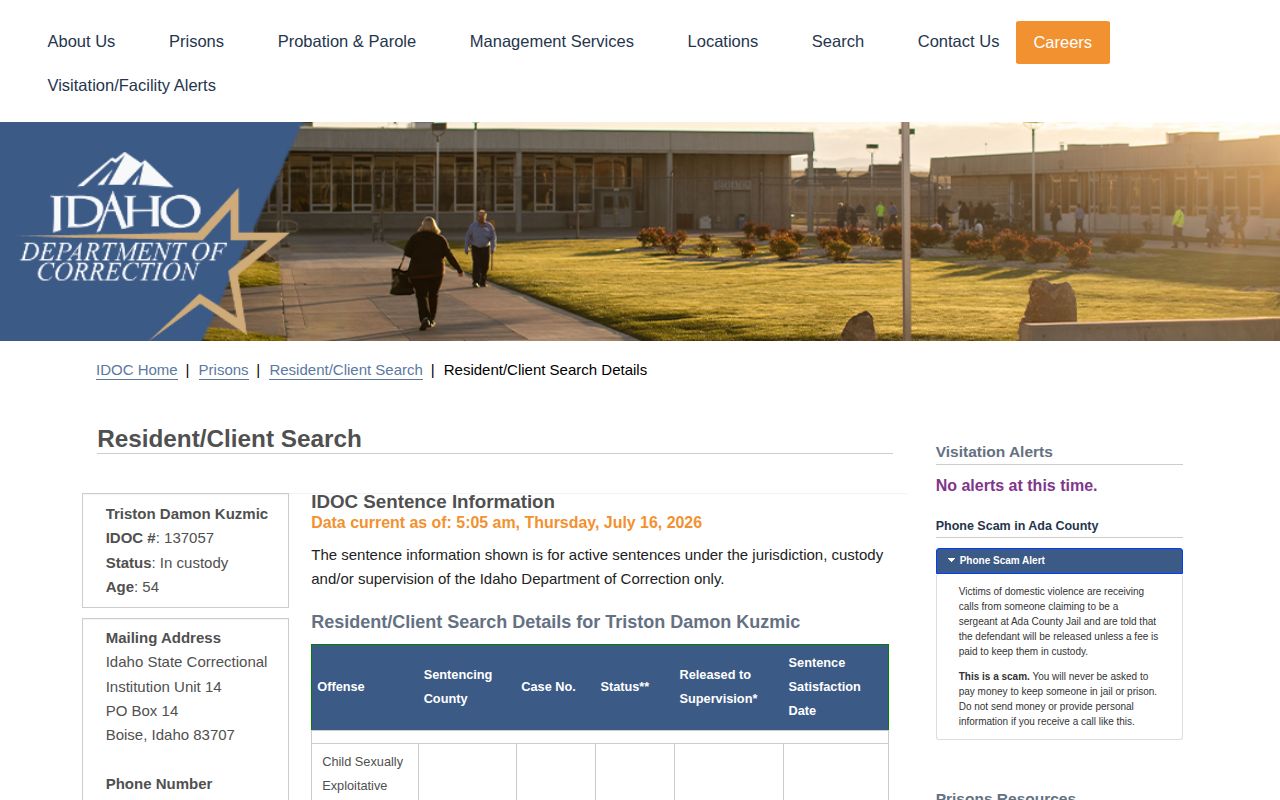
The image demonstrates why the label must travel with the date; it does not establish a current date for another person.
For alerts about a specific participating custody record, the Bear Lake County VINELink check explains event notices and their limits. IDOC and Commission records should still confirm a state-prison release.
When a public IDOC result has become a sparse satisfied-sentence entry, request the public sentence computation and actual institutional release entry. Identify the IDOC number, Bear Lake court case, sentencing county, and approximate dates. A focused request can ask for the sentence effective date, credited time, fixed term, parole eligibility, first parole release, scheduled termination, and discharge status.
Commission summary minutes are useful when an older action notice no longer appears online. Name the hearing session and IDOC number. Minutes can explain whether parole was granted, denied, deferred, or revoked, but IDOC still holds the completed release-to-supervision event. The court remains the source for an amended sentence or credit order.
If a projected date passes with no public status change, allow for the stated daily update lag, then contact the proper records office. Do not infer release from silence. A program condition, incomplete parole plan, new hold, correction, or transfer may explain the difference. Ask which dated event occurred and which agency received the person, if any.